

Enrique Martínez Celaya creates a monumental new artwork for LA Opera's 2026/27 season

/03-cosi/_dsc0996_pr.jpg?format=auto&fit=crop&w=345&h=200&auto=format)



Make a tax-deductible donation today, and you'll play a starring role in bringing opera to the stage by funding the efforts of the hundreds of artists and staff, who move us with their work.

On Saturday, October 17, 2026, LA Opera will celebrate its 40th birthday with a very special gala celebration following the opening night performance of Carmen.


Throughout LA Opera's 2026/27 season, audiences at the Dorothy Chandler Pavilion will encounter something extraordinary before a single note is heard.
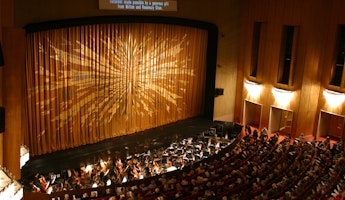
LA Opera has commissioned acclaimed Los Angeles-based artist Enrique Martínez Celaya to create The Things We Know, a monumental artwork spanning approximately 60 feet across the Dorothy Chandler Pavilion stage. But the piece isn't meant to be experienced all at once. It reveals itself gradually—transforming as the curtain rises and the audience prepares to enter the world of the opera.
At first, two children appear absorbed by the small worlds before them: a girl holds an aquarium, while a boy reaches toward a bird inside a cage. Moments before the performance begins, the curtain rises. The familiar scene gives way to stars, flowers and fractured light before disappearing completely into darkness. And from that darkness, the opera begins.
A Visual Prelude
“Enrique is not only an extraordinary visual artist, but also a poet and philosopher,” said Christopher Koelsch, LA Opera’s President and CEO. “That makes him an especially compelling artist for an opera house—a place where image, language, music and ideas converge. The Things We Know transforms the curtain from a boundary into a kind of visual prelude, making the audience’s arrival part of the artistic experience before a single note is heard.”
In the Artist's Words
"The curtain begins with two children and two small, contained worlds. A girl holds an aquarium. A boy reaches toward a bird inside a cage. Both of them seem absorbed by the animals before them, though it is difficult to say what kind of absorption it is. There is curiosity in it and mystery about what is not understood, but perhaps also concern, or an early awareness that care and confinement can sometimes resemble one another. Above them is a pale form that might be a shelter, a dome, or a mark for something taking place underneath it.
"There are fragments of writing around the children. With effort, some words can be read—weeping, home, raked, large—but what they tell cannot be deciphered, and I do not think it needs to be. They establish another register within the image, one belonging to language, memory, and the attempt to give experience a form. The children, the animals, the writing, and the shelter belong to a recognizable world. Yet something else is seeping into this intimate and domestic scene. Along the lower part of the figures are small points of light that resemble stars or constellations. Not much of them can be seen, so they might appear to be simply marks on the children or on their clothing. Only later will their significance become clear.
"A curtain is different from a painting on a wall because it has a life in time. A curtain waits. Then, somewhat unexpectedly for the seated audience that has lost track of time in conversation, it moves. I wanted that movement to be part of the work rather than merely something that happened to it.
"For the period before the performance, the audience sees only the upper portion of the image. The curtain bottom ends near the place where the constellations begin. For 30 or 40 minutes, then, the encounter is primarily with the children and the animals. There is time to wonder about them. Why children? Am I supposed to make sense of the writing? Why are the animals contained? Are these limits placed around a life? What are the children doing with them? Is the boy trying to touch the bird, release it, play with it, or maybe something else, something darker? What does the girl see when she looks into the small world she carries? I am not interested in making the image puzzling, or in suggesting that these questions have to be answered. What matters to me is the place they seem to border or point to, something we might recognize without being able to name or explain it.
"When the performance is about to begin, the curtain rises and the nature of the image changes. Half the curtain has been hidden. What appeared to be a few constellations touching the children is revealed as part of a much larger field. The recognizable world gives way to a starry night. Flowers appear there, along with shards or prisms that catch and divide light. What had seemed incidental to the scene above becomes another order of reality. The protective dome slowly disappears upward first, then the children. So do the animals, the cage, the aquarium, and the writing. What remains are the flowers, the fractured light, and the field of stars. Then these disappear as well. Eventually the painted curtain is gone and there is only the black curtain behind it. The performance begins from that darkness.
"I have long been interested in the friction between the scale at which we live and the scale of what surrounds us. Much of a life is made from very small things: a room, a child looking at an animal, the wish to protect something, the fear that it might disappear. Every one of these experiences takes place within movements of time, history, and matter that are almost impossible to know, and often unknowable. We recognize this, but ordinarily we cannot live with that knowledge continuously. Consciousness seems to move between these scales, between the immediate world we can hold and the larger one in which that world is always passing away. Childhood makes this tension visible. Childhood is a moment in a life. A child can be absorbed by something small while standing very close to questions that have no small answer. What is alive? What is freedom and what is confinement? What does it mean to care for something? What disappears, and where does it go? These questions often first appear as attention.
"The movement of the curtain allows these two scales to occupy the same work without resolving them. The domestic scene is not displaced by the larger field beneath it, nor is the field more true simply because it is larger. They belong to one another. The stars are already present on the children before we understand what they are. The darkness is already there beneath the flowers. What changes is not the world itself, but how much of it we are allowed to see. Perhaps this is also why the final disappearance matters to me. The curtain does not rise to reveal an answer. It rises until the image itself is gone. For a brief interval there is only darkness. And from that darkness another world, the world of the opera, begins. "
Meet Enrique Martínez Celaya
Enrique Martínez Celaya is a Cuban-born artist, author and former scientist whose multidisciplinary practice encompasses painting, sculpture, drawing, immersive environments and writing. His work explores the experience of the individual amid social, ethical and existential conditions, and the capacity of art to widen perception and lend structure to meaning. His work has been exhibited internationally and is represented in more than 60 public collections, including the Metropolitan Museum of Art, the Whitney Museum of American Art, the Los Angeles County Museum of Art, The Huntington, the Moderna Museet in Stockholm and the Museum of Fine Arts, Houston.
Martínez Celaya has created major projects and installations for institutions around the world, including the State Hermitage Museum in St. Petersburg, The Phillips Collection in Washington, D.C., the Berliner Philharmonie in Berlin and the Museo Nacional de Bellas Artes in Havana. His work has also been presented in two-person exhibitions with such historical artists as Albert Pinkham Ryder, Käthe Kollwitz and Diego Velázquez.
An accomplished writer as well as a visual artist, Martínez Celaya is the author of nine books on art, philosophy and poetry, including two volumes of Collected Writings and Interviews published by the University of Nebraska Press. His work has been the subject of 14 monographic publications. His forthcoming books include Tending the Fire: Creativity, Purpose, and the Unfolding Self, co-authored with Jungian psychoanalyst James Hollis, and Pebbles: The Commonalities and Divergences of Art and Science, written with Nobel Prize-winning chemist Roald Hoffmann and philosopher and physicist Aleksandr P. Svitin.
Martínez Celaya is the first Provost Professor of Humanities and Arts in the history of the University of Southern California, where his teaching integrates literature, philosophy and art. In 2025, he received USC's highest faculty honor, the Associates Award for Artistic Achievement.
His unusual path to the visual arts began early. Martínez Celaya trained as a painter's apprentice at the age of 12 and, at 16, built a laser that received national recognition. He studied applied physics, literature and art at Cornell University before pursuing graduate work in quantum electronics at the University of California, Berkeley. Before devoting himself fully to art, he received patents and published scientific papers in laser physics and superconductivity. He later earned his M.F.A. from the University of California, Santa Barbara. Martínez Celaya lives and works in Los Angeles.
Learn more about the artist at MartinezCelaya.com.
The Things We Know by Enrique Martínez Celaya is generously underwritten by Mei-Lee Ney

Photo: Saam Gabbay

Photo: Saam Gabbay

Photo: Saam Gabbay

Photo: Kwaku Alston

Photo: Saam Gabbay


