


/03-cosi/_dsc0996_pr.jpg?format=auto&fit=crop&w=345&h=200&auto=format)





Blog
September 1, 2026
From Canvas to Curtain: Artist Enrique Martínez Celaya Takes Center Stage
Before the first note sounds, the performance has already begun.
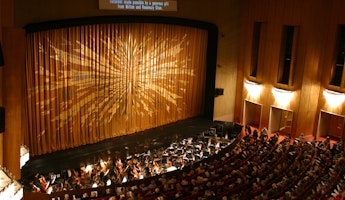
Stretching approximately 70 feet across the stage of the Dorothy Chandler Pavilion, The Things We Know is a monumental new artwork by Los Angeles-based artist Enrique Martínez Celaya, commissioned by LA Opera for the 2026/27 season. The work transforms one of the theater's most familiar objects—the curtain—into an artistic experience that unfolds over time.
Audiences first encounter a depiction of two children. But that intimate scene is only part of the work. Moments before each performance begins, the curtain slowly rises, revealing an entirely different world hidden below.
In the Artist's Words
"The curtain begins with two children and two small, contained worlds. A girl holds an aquarium. A boy reaches toward a bird inside a cage. Both of them seem absorbed by the animals before them, though it is difficult to say what kind of absorption it is. There is curiosity in it and mystery about what is not understood, but perhaps also concern, or an early awareness that care and confinement can sometimes resemble one another. Above them is a pale form that might be a shelter, a dome, or a mark for something taking place underneath it.
"There are fragments of writing around the children. With effort, some words can be read—weeping, home, raked, large—but what they tell cannot be deciphered, and I do not think it needs to be. They establish another register within the image, one belonging to language, memory, and the attempt to give experience a form. The children, the animals, the writing, and the shelter belong to a recognizable world. Yet something else is seeping into this intimate and domestic scene. Along the lower part of the figures are small points of light that resemble stars or constellations. Not much of them can be seen, so they might appear to be simply marks on the children or on their clothing. Only later will their significance become clear.
"A curtain is different from a painting on a wall because it has a life in time. A curtain waits. Then, somewhat unexpectedly for the seated audience that has lost track of time in conversation, it moves. I wanted that movement to be part of the work rather than merely something that happened to it.
"For the period before the performance, the audience sees only the upper portion of the image. The curtain bottom ends near the place where the constellations begin. For thirty or forty minutes, then, the encounter is primarily with the children and the animals. There is time to wonder about them. Why children? Am I supposed to make sense of the writing? Why are the animals contained? Are these limits placed around a life? What are the children doing with them? Is the boy trying to touch the bird, release it, play with it, or maybe something else, something darker? What does the girl see when she looks into the small world she carries? I am not interested in making the image puzzling, or in suggesting that these questions have to be answered. What matters to me is the place they seem to border or point to, something we might recognize without being able to name or explain it.
"When the performance is about to begin, the curtain rises and the nature of the image changes. Half the curtain has been hidden. What appeared to be a few constellations touching the children is revealed as part of a much larger field. The recognizable world gives way to a starry night. Flowers appear there, along with shards or prisms that catch and divide light. What had seemed incidental to the scene above becomes another order of reality. The protective dome slowly disappears upward first, then the children. So do the animals, the cage, the aquarium, and the writing. What remains are the flowers, the fractured light, and the field of stars. Then these disappear as well. Eventually the painted curtain is gone and there is only the black curtain behind it. The performance begins from that darkness.
"I have long been interested in the friction between the scale at which we live and the scale of what surrounds us. Much of a life is made from very small things: a room, a child looking at an animal, the wish to protect something, the fear that it might disappear. Every one of these experiences takes place within movements of time, history, and matter that are almost impossible to know, and often unknowable. We recognize this, but ordinarily we cannot live with that knowledge continuously. Consciousness seems to move between these scales, between the immediate world we can hold and the larger one in which that world is always passing away. Childhood makes this tension visible. Childhood is a moment in a life. A child can be absorbed by something small while standing very close to questions that have no small answer. What is alive? What is freedom and what is confinement? What does it mean to care for something? What disappears, and where does it go? These questions often first appear as attention.
"The movement of the curtain allows these two scales to occupy the same work without resolving them. The domestic scene is not displaced by the larger field beneath it, nor is the field more true simply because it is larger. They belong to one another. The stars are already present on the children before we understand what they are. The darkness is already there beneath the flowers. What changes is not the world itself, but how much of it we are allowed to see. Perhaps this is also why the final disappearance matters to me. The curtain does not rise to reveal an answer. It rises until the image itself is gone. For a brief interval, there is only darkness. And from that darkness another world, the world of the opera, begins."
The Things We Know by Enrique Martínez Celaya is generously underwritten by Mei-Lee Ney.