



/03-cosi/_dsc0996_pr.jpg?format=auto&fit=crop&w=345&h=200&auto=format)




Blog
October 1, 2026
From Page to Stage: "Candide," Behind the Masterpiece
One of the greatest works in Western literature, Voltaire’s 1759 novel Candide, or Optimism follows its wide-eyed hero on a whirlwind tour throughout much of the known world. Leonard Bernstein’s 1956 musical take on Voltaire followed almost as many twists and turns on its journey from Broadway to the opera house.
This is a story rich and rare,
of philosophic interplay,
‘twixt optimism and despair
by François-Marie Arouet,
who called himself Voltaire.
“Voltaire Chorale,” the opening number of Bernstein’s Candide
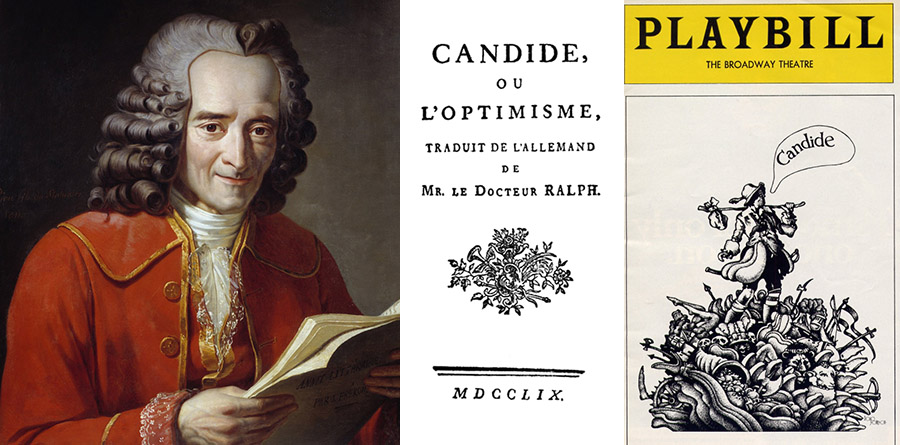
From page to stage: Voltaire, the 1759 title page of his novel, and the Playbill for the original 1956 Broadway production.
Voltaire was the pen name of François-Marie Arouet (1694–1778), a hero of the French Enlightenment’s progressive ideals. He was a staggeringly prolific philosopher, playwright, poet, historian and author, who had a knack for making his points in pithy aphorisms (including “If God did not exist, it would be necessary to invent Him”). In his 1759 novel Candide, he attacked intolerance, corruption and established religion. His writing popularized ideas that had previously been clandestine, spurring public opinion into action and helping to create change throughout Europe.
“Optimism,” as espoused by Dr. Pangloss throughout Candide, doesn’t simply mean looking on the bright side of things. Optimism was a philosophy promoted by, among others, Gottfried Wilhelm Leibniz (1646–1716), who stated that we live in “the best of all possible worlds.” Since the universe was created by a perfect and all-knowing God, he believed, everything in it is rationally ordered according to God’s perfect plan and everything that happens is for the best. Horrified by the 1755 Lisbon earthquake, which killed tens of thousands of people, Voltaire relentlessly ridiculed this philosophy in Candide.
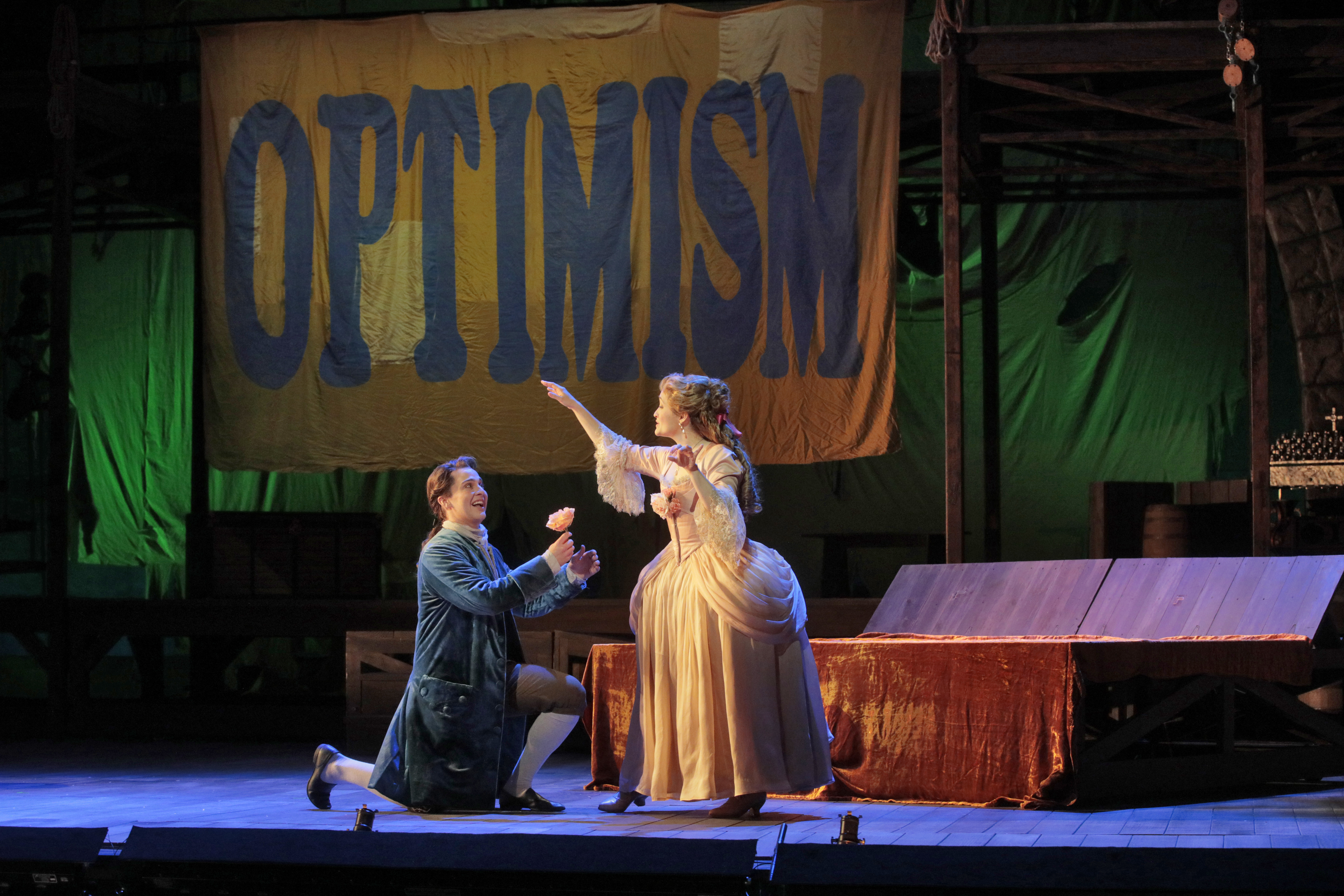
Optimism took center stage in LA Opera’s 2017 production of Candide.
First published in 1759, Candide was an immediate sensation. Though banned in several countries, 17 editions appeared throughout Europe that year. It has been translated into every major language around the world, has never gone out of print, and remains a much-loved literary landmark of the European Enlightenment. Its tale of a sweet-natured young man enduring an unending series of tragedies is just as engaging, funny and stinging today as it was nearly 270 years ago. Candide asks enduring questions: If God is good, why does He allow evil to exist? How can one explain human cruelty or natural disasters?
The Long Road to Broadway
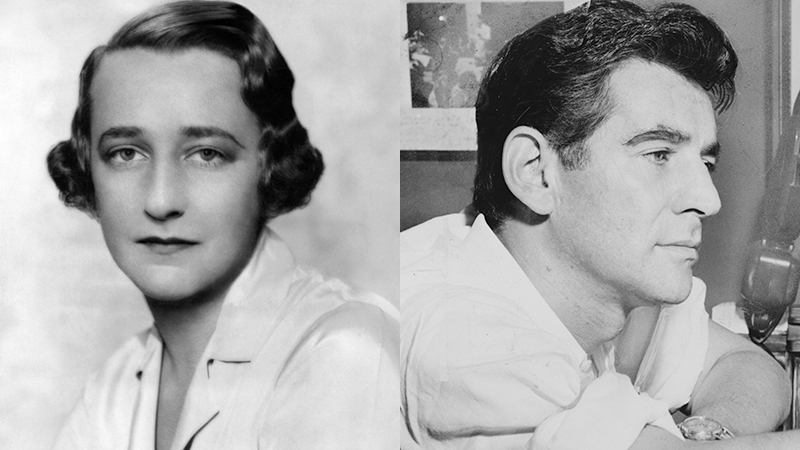
Lillian Hellman and Leonard Bernstein
Playwright Lillian Hellman (1905-1984), whose most famous stage works included The Children’s Hour and The Little Foxes, was blacklisted by Hollywood in the 1950s for her leftist activism. In 1953, seeing parallels between McCarthyism and the intolerance Voltaire had attacked in Candide, Hellman approached Leonard Bernstein with the idea of adapting the novel into a play. Bernstein agreed to compose incidental music but became so fascinated by the subject that he persuaded her that it should be a “comic operetta.” Hellman got to work on her script.
Composer Leonard Bernstein (1918-1990) was a bona fide celebrity by the time he was working on Candide, with a flourishing conducting career and two Broadway hits under his belt: On the Town and Wonderful Town. He was simultaneously working on West Side Story, which opened a year after Candide. Two numbers originally written for Candide turned up in West Side Story with different lyrics: the duet “One Hand, One Heart” and “Gee, Officer Krupke.” A discarded duet for West Side Story was recycled as Candide’s “Oh, Happy We.” Bernstein would become music director of the New York Philharmonic in 1958.
The road to Broadway had plenty of bumps. Hellman and Bernstein enlisted songwriter John La Touche as lyricist, but the collaboration proved difficult. They parted ways and poet Richard Wilbur took over as principal lyricist. Bernstein, Hellman and Dorothy Parker also supplied lyrics, and poet James Agee briefly worked on the project before his death in 1955. His contributions went unused. Looking back on the original production, Parker offered a characteristically sharp verdict: “there were too many geniuses involved.” Even this dream team couldn’t guarantee a lasting popular hit on Broadway.
After a troubled development and hectic tryout in Boston, Candide opened on Broadway on December 1, 1956. The show was lavishly staged by Tyrone Guthrie and featured a huge cast of 42. Reviews were mixed: critics praised the sparkling score and its stars, but some found Hellman’s book leaden. Influential critic Walter Kerr panned Candide as a “really spectacular disaster.” The show never caught on with audiences and closed after only 73 performances. But Candide wasn’t dead yet. The original cast album proved far more successful than the show itself, keeping Bernstein’s score alive and helping Candide become something of a cult favorite.
Two Leading Ladies Steal the Show
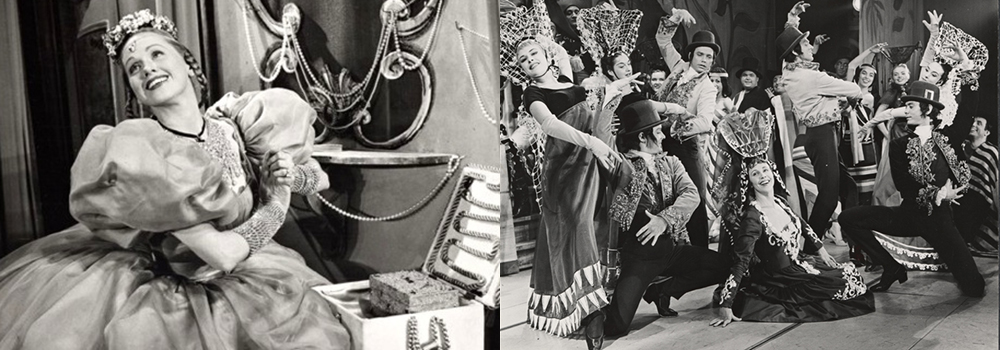
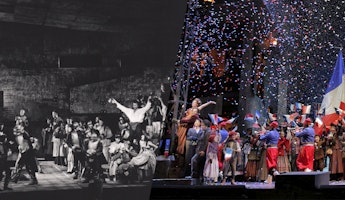
Left: Barbara Cook as Cunegonde, singing “Glitter and Be Gay” in the original 1956 Broadway production. Right: Irra Petina as the Old Lady, performing “The Old Lady’s Tango” with the Broadway cast.
Barbara Cook was still a rising Broadway performer when she auditioned for Candide, with four leading roles already to her credit. While waiting for Bernstein to arrive, she was shown the music for Cunegonde’s “Glitter and Be Gay”—a formidable coloratura showpiece whose stratospheric demands included several E-flats above high C. Cook began her audition with her usual number, “Make the Man Love Me” from A Tree Grows in Brooklyn. Knowing Bernstein would want to hear what she could do with the high notes, she offered Cio-Cio-San’s entrance from Madama Butterfly, which she’d never sung outside her voice teacher’s studio. “I took the optional high D-flat—and I sang the bejeezus out of it,” she later recalled. “You have great musical courage,” Bernstein said, impressed. “You mean I’ve got a lot of guts,” replied Cook. Bolstered by her triumph as Cunegonde, she went on to create the roles of Marian in The Music Man and Amalia in She Loves Me. She later became an iconic concert artist, singing well into her eighties.
One of the score’s many highlights is the rollicking “I Am Easily Assimilated,” introduced by Irra Petina as the Old Lady, who explains her knack for fitting in wherever she lands. It has no exact counterpart in Voltaire’s novel. Bernstein wrote the lyrics himself, his Chilean-raised wife Felicia contributing the Spanish verses. “My mother came from Rovno Gubernya,” the Old Lady sings, giving this globe-trotting survivor a decidedly personal touch—and paying tribute to Bernstein’s father, who was born in the region and later immigrated to America. Blending Latin rhythms with klezmer sounds, the composer called it a “Jewish tango” and playfully marked his manuscript “moderato hassidicamente”—an instruction to bring a little extra Hasidic flavor.
From Flop to Favorite
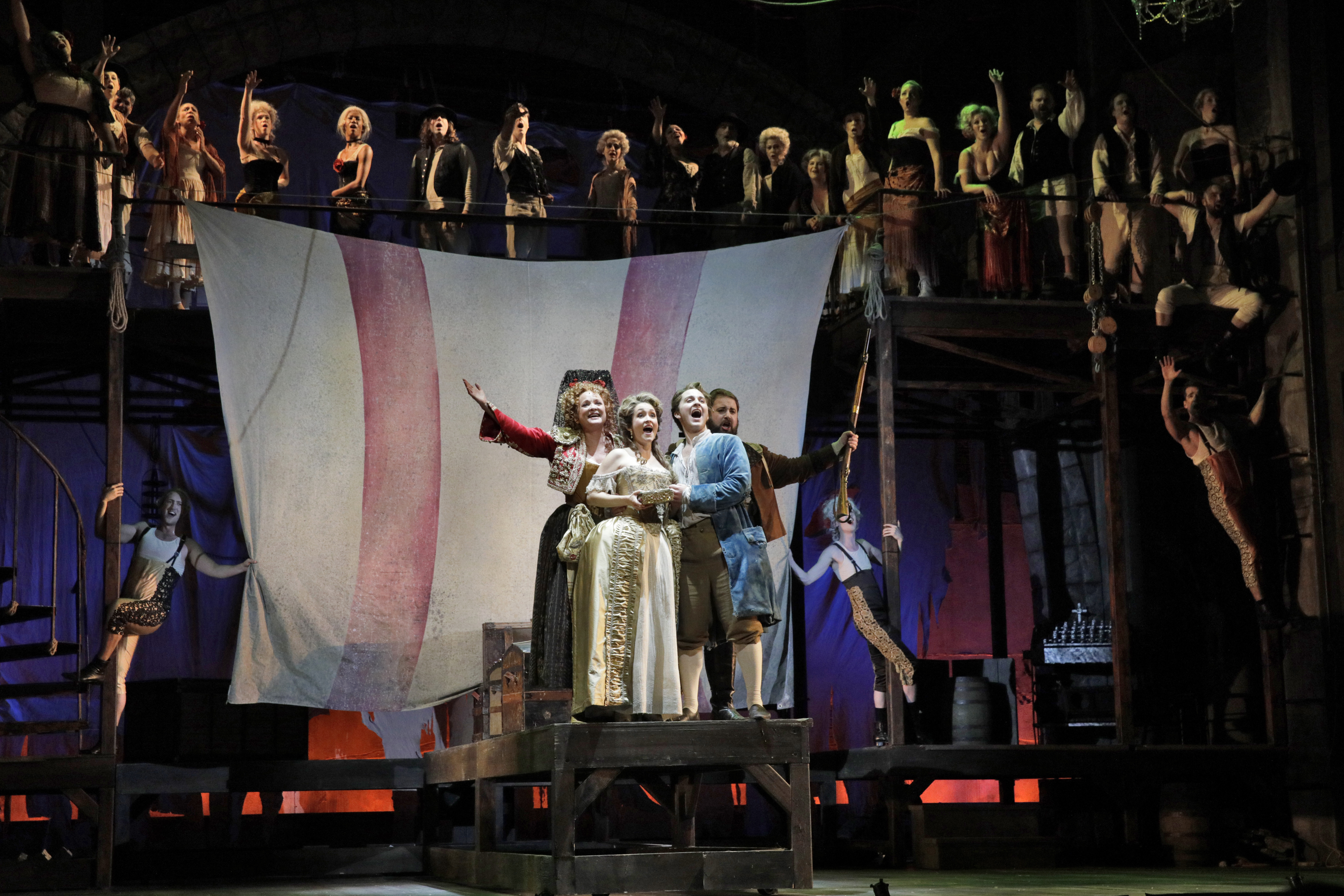
Candide in full swing: the Act One finale of LA Opera’s 2017 production
The brilliance of Bernstein’s score inspired its many admirers to bring Candide back to life. Hellman, however, wanted nothing to do with it and refused to allow any of her work to be used again. For a 1973 revival, inventively directed by Hal Prince, Hugh Wheeler devised an entirely new book and Stephen Sondheim was called upon to add new lyrics. This time, Candide worked. Crusty Walter Kerr even reversed his opinion, calling it “an evening of enormous charm.” It transferred to Broadway, where it ran nearly two years. In 1982, Candide was adapted for New York City Opera, launching its entry into the repertoire of opera houses around the world.
Click here to get tickets to see Candide.